We recently attended the British Aphasiology Society (BAS) Conference 2026 in Cardiff which brought together researchers, clinicians, and people with lived experience under the theme "Living well with aphasia". The conference provided an excellent opportunity to network and share our work. The team contributed to the programme in a number of ways.
Read moreProfessor Rosemary Varley Receives the 2026 Robin Tavistock Award
We are pleased to share that Professor Rosemary Varley is the recipient of the 2026 Robin Tavistock Award.
The Robin Tavistock Award is a prestigious international award presented annually to an individual or group whose work has made an inspirational and significant contribution to the field of aphasia.
This well-deserved recognition celebrates Professor Varley's longstanding contributions to aphasia research and education.
To learn more about the Robin Tavistock Award, please visit the Tavistock Trust for Aphasia website: https://aphasiatavistocktrust.org/robin-tavistock-award/
Exhibit at British Academy Ideas Festival
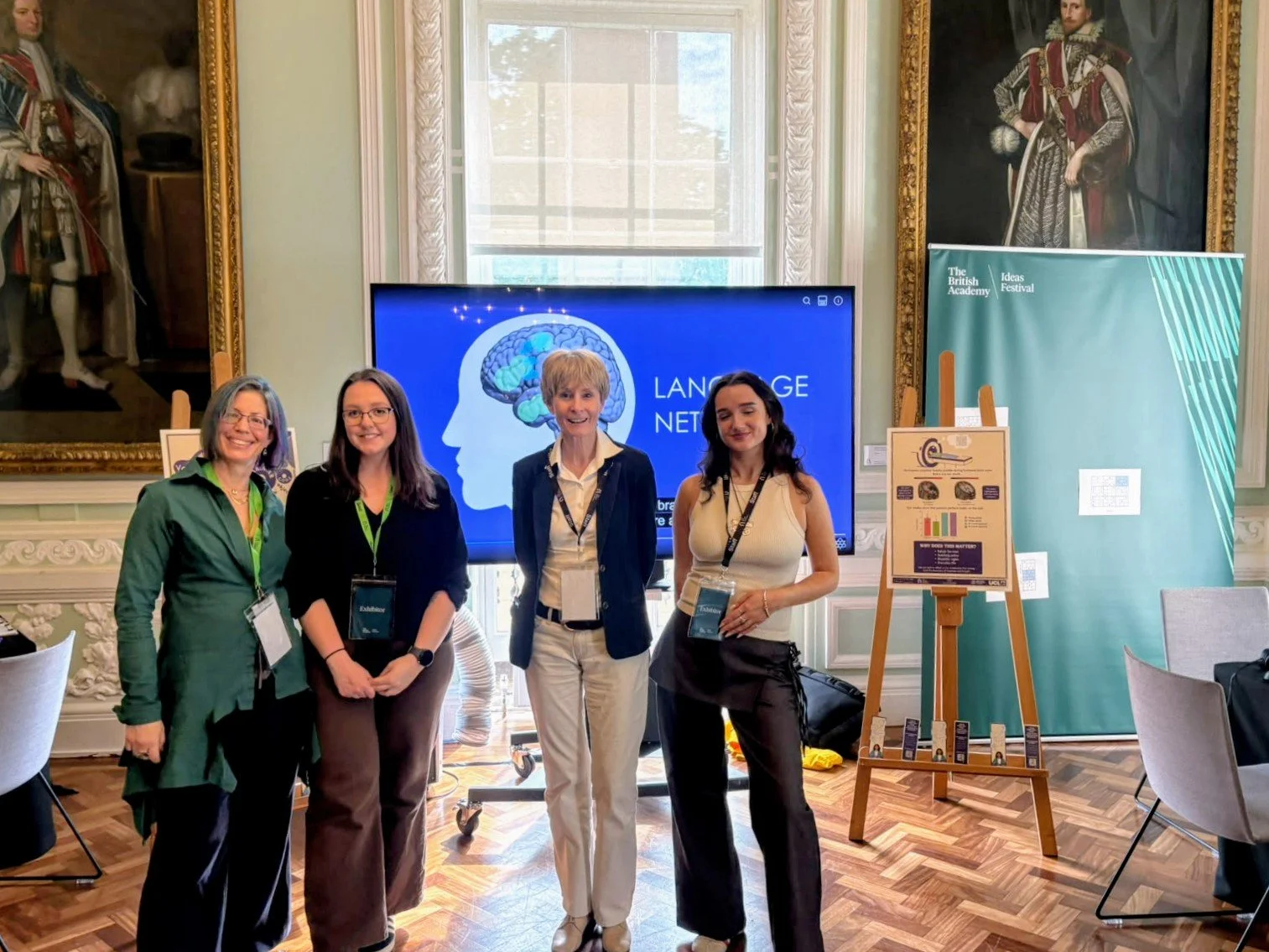
With Yael Benn and colleagues from Manchester Metropolitan University, we took part in The British Academy Ideas Festival in London (June 2026).
Our exhibit was entitled 'I speak therefore I think?' and examined whether words and sentences are necessary for sophisticated thinking. An animation on the background to the research can be accessed at: https://www.mmu.ac.uk/about-us/faculties/health-and-education/research/projects/language-of-thought
Photo: from left - Yael Benn; Rebecca Nelson; Rosemary Varley; Leela Noon
Bye bye India and Kerry (or rather, see you soon)!
India’s placement is coming to an end at the beginning of June (time really flew by), and she has been a fantastic asset to the team. We are glad that she will stay in touch over the summer, and we wish her a brilliant final year at Cardiff University.
Kerry will also leave us - but luckily only temporarily - to go on maternity leave from June. We can’t wait to meet the new team member (watch this space).
All the best to both of you!
Read moreMSc student SLTs working with UTILISE
UCL Speech and Language Sciences students Nabeela Hussain and Poppi Dickens will complete independent projects on the UTILISE-2 study as part of the Speech and Language Therapy MSc qualifications. Nabeela and Poppi are following their own interests within the study on the UTILISE app. They are working hard on transcribing and preparing the data for their chosen analyses. We look forward to working with them this academic year!
Welcome India!
The UTILISE team are excited to be hosting a research placement with India Bamrah, BSc Psychology student from Cardiff University. India will be working closely with Rosemary, Claudia and Kerry to prepare data for the UTILISE-2 study and a crossover pilot study exploring the effect of ordering UTILISE before or after a word app. India will also join sessions and focus groups to learn more about the experience of people with aphasia and skills to support their communication. We’re thrilled India will be with us for the academic year 2024-2025!

A wonderful summer placement with Jieun Kim from Mount Holyoke College, USA
Undergraduate Jieun Kim joined the UTILISE team for 3 months from May to August 2024. We loved working with Jieun! Here Jieun reflects on her experience:

“Hello all, my name is Jieun Kim, and I am an undergraduate student originally from South Korea who just turned junior (Year 3) at Mount Holyoke College in the US. It feels nostalgic and really nice to reflect on this wonderful summer back by writing this blog post.
This summer, I had the incredible opportunity to intern at the UCL Cognition and Grammar Lab, working on the UTILISE project under the guidance of Professor Varley, Kerry, and Claudia. Reflecting on the past few months, I’m filled with a sense of gratitude for the experience and the insights I’ve gained.
One of the most impactful aspects of this internship was working with participants who have aphasia. Observing their interactions during sessions and the focus group gave me a deep appreciation for the complexity of communication and the challenges people with aphasia face. It was humbling to witness their perseverance, and it made me even more committed to supporting work that could help improve their quality of life.
The technical tasks -- like navigating the British National Corpus and working on data spreadsheets -- were equally enriching. Though at first, some tasks seemed new, I quickly realized how much I was learning about research methodologies, data management, and the precision required in linguistic studies. Transcribing speech for hours on end taught me patience and attention to detail, and it was an opportunity for me to study subtle phonetical features of individual speech production. Also, creating accessible materials for people with aphasia made me understand what kind of help people with aphasia might need.
Overall, this internship gave me more than just new skills -- it broadened my viewpoint in terms of the language sciences and allowed me to perceive the complexity of interdisciplinary areas in neurolinguistics and speech-language pathology. I’m incredibly grateful for the support I received from the team and for the chance to play a small role in research that could help individuals with communication difficulties. It was a summer of learning, growth, and connection, and I’ll carry these lessons with me as I move forward in my studies and career.
I would like to appreciate again every experience, kindness, and warm welcome from everyone with my whole heart, and I wish all the best for the research as well as their personal lives 🥰 “
We are in deep sorrow at the loss of lab member Sebastian

We are in deep sorrow at the loss of lab member Sebastian Bello Lepe, who died on Christmas Day. It was a total pleasure to work with him: always positive and enthusiastic. He remained positive even when the pandemic interrupted our plans for his PhD and amazingly flexible in changing direction as it was clear that we could not recruit participants with stroke for the planned studies. Instead, he conducted secondary analysis of existing data and produced outstanding work on the analysis of pause phenomena in the speech of people with aphasia and those with Alzheimer's disease. Once the restrictions of the pandemic were lifted, he completed a major EEG study on brain electrical responses to grammatical anomalies in older adults and aphasic listeners. He heard very recently that his article reporting the pause analysis in aphasia was accepted for publication in Cortex. We will miss Seb and his energy and enthusiasm, and we will not forget his contributions to the work of the lab.
We are in deep sorrow at the loss of lab member Sebastian Bello Lepe, who died on Christmas Day.
Read moreTae's Tandem! 🪂
The UTILISE team are excited to share that team member, Tae, has completed her skydive!
After a couple of dates were cancelled thanks to classic British summer weather, Tae was finally able to go ahead with the jump, which she faced to raise money for aphasia charity Dyscover.
Her brave feat raised over £1000 for the organisation which supports people living with aphasia. Formerly afraid of heights, her fears were conquered for a fantastic cause, and we’ll be interested to see whether Tae becomes a full extreme-sports convert…
Well done, Tae!!! 👏

BAS Conference - Kerry is our Rising Research Star! 🌟
The UTILISE team have been busy spreading the word about our work at international conferences over the last couple of months.
In September, Kerry presented (twice!) at the British Aphasiology Society (BAS) Conference, which was held in London at UCL Queen Square. She spoke about outcomes of our pilot trial, both qualitative and quantitative, which we ran earlier in the year. We would like to thank all the participants of the pilot trial for their work using the app and for their attendance at focus groups. These participants gave us valuable insight into their experiences and shared their suggestions for improving the app. Kerry presented these insights as part of her presentations, highlighting the importance of developing effective remote therapy options to maximise dose potential for patients.
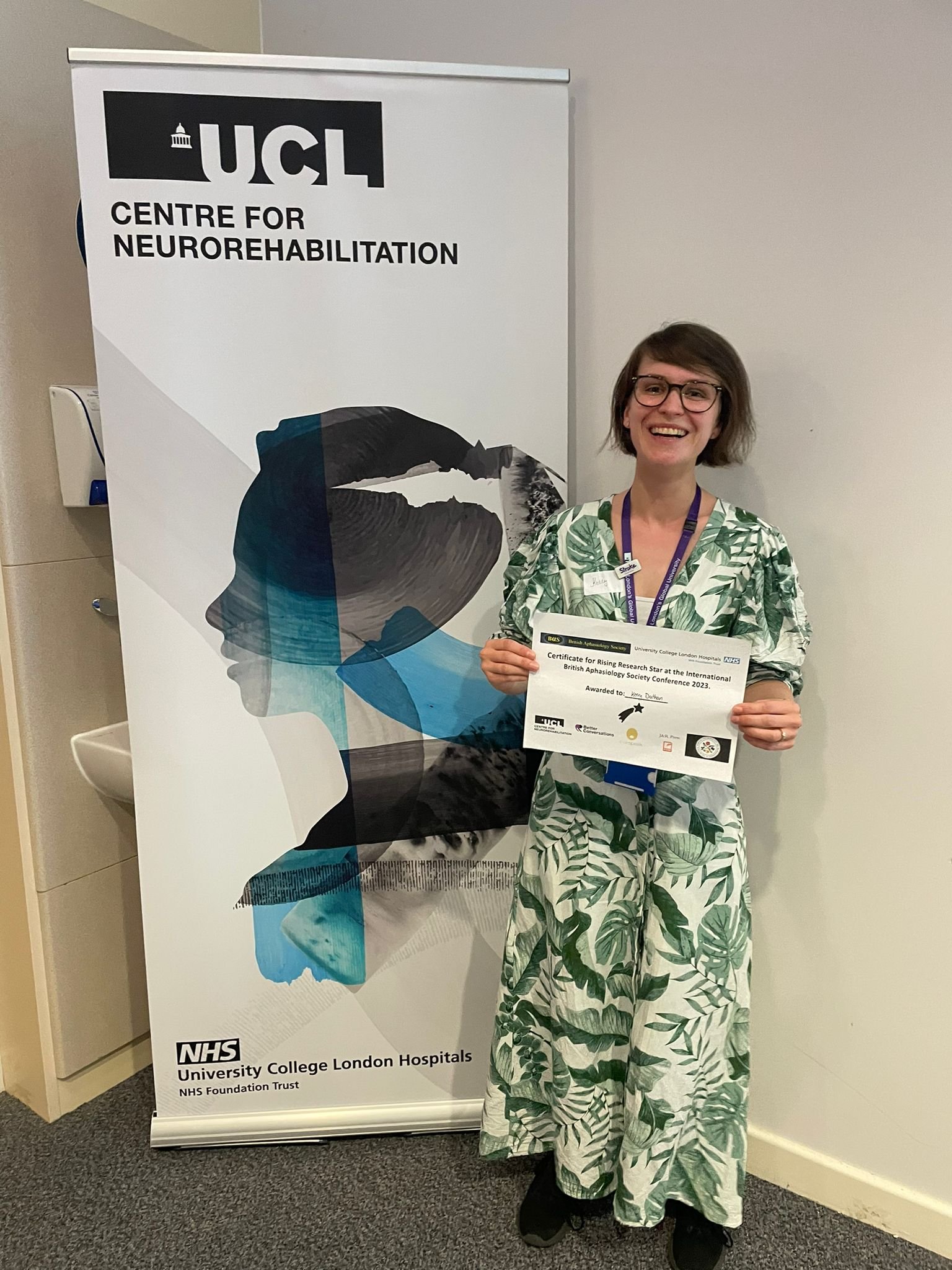
Kerry Dathan at the British Aphasiology Society Conference with her Rising Research Star award.
We would also like to thank the BAS team for giving us the opportunity to present our work. It was a terrific 3-day event with lots of fascinating talks, including some from service users. UTILISE team member Fern also presented a poster, sharing some outcomes from our in-person therapy trial.
We are very proud that Kerry was awarded the “Rising Research Star” award for her contributions to the conference. She is, without doubt, already a star, and has a bright research career ahead of her.
Well done, Kerry! A true asset to the team.